Quick answer: In Singapore, WhatsApp Business charges you per message you send through the API. As of July 2026, marketing messages cost about S$0.0937 each, while utility and authentication messages cost about S$0.0205 each. Service replies (your answers inside a customer's 24-hour window) are free today, but that changes on 1 October 2026, when Meta begins charging for them too. The WhatsApp Business app on your phone stays free; the costs below apply to the WhatsApp Business Platform (API), which you access through a provider.
Below is the full 2026 breakdown for Singapore businesses: how the pricing model actually works, what you still get for free, worked cost examples in SGD, and the practical levers, including the PSG grant — that bring your bill down.
WhatsApp Business Pricing at a Glance
There are three ways to be on WhatsApp for business, and only one of them carries per-message costs.
| Option | What it is | Cost |
|---|---|---|
| WhatsApp Business app | The free phone app for micro-businesses. Manual replies, one device. | Free |
| Meta Verified | An optional paid subscription that adds a verified badge and support. | Monthly subscription |
| WhatsApp Business Platform (API) | The scalable version for automation, broadcasts and multi-agent teams. Accessed through a Business Solution Provider (BSP). | Per-message fees + BSP platform fee |
The rest of this guide is about the third option — the WhatsApp Business Platform, formerly called the WhatsApp Business API because that's where "pricing" questions actually apply.
The Two Ways to Use WhatsApp for Business
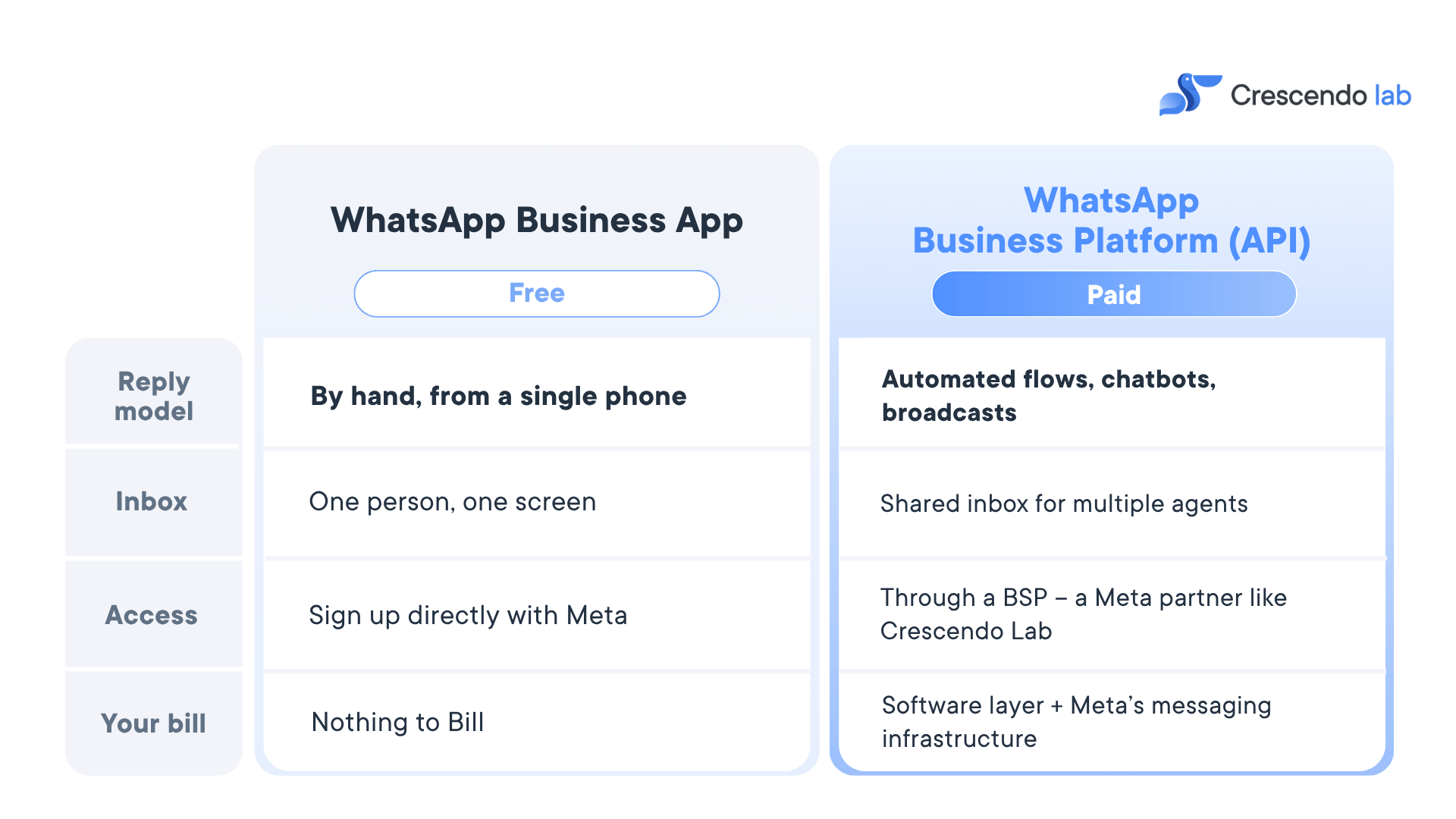 The WhatsApp Business app is free to download and use. It's built for solo operators and small shops: you reply by hand from a single phone, and there's no automation or team inbox. It's fine until volume outgrows one person tapping on a screen.
The WhatsApp Business Platform (API) is what growing brands use. It supports automated flows, broadcast campaigns, chatbots, and a shared inbox for multiple agents. You can't sign up for it directly from Meta. You connect through a BSP (a Meta partner such as Crescendo Lab) that gives you the software layer on top of Meta's messaging infrastructure. That's why your bill has two parts, which we'll come back to.
How WhatsApp Business API Pricing Works in 2026 (the per-message model)?
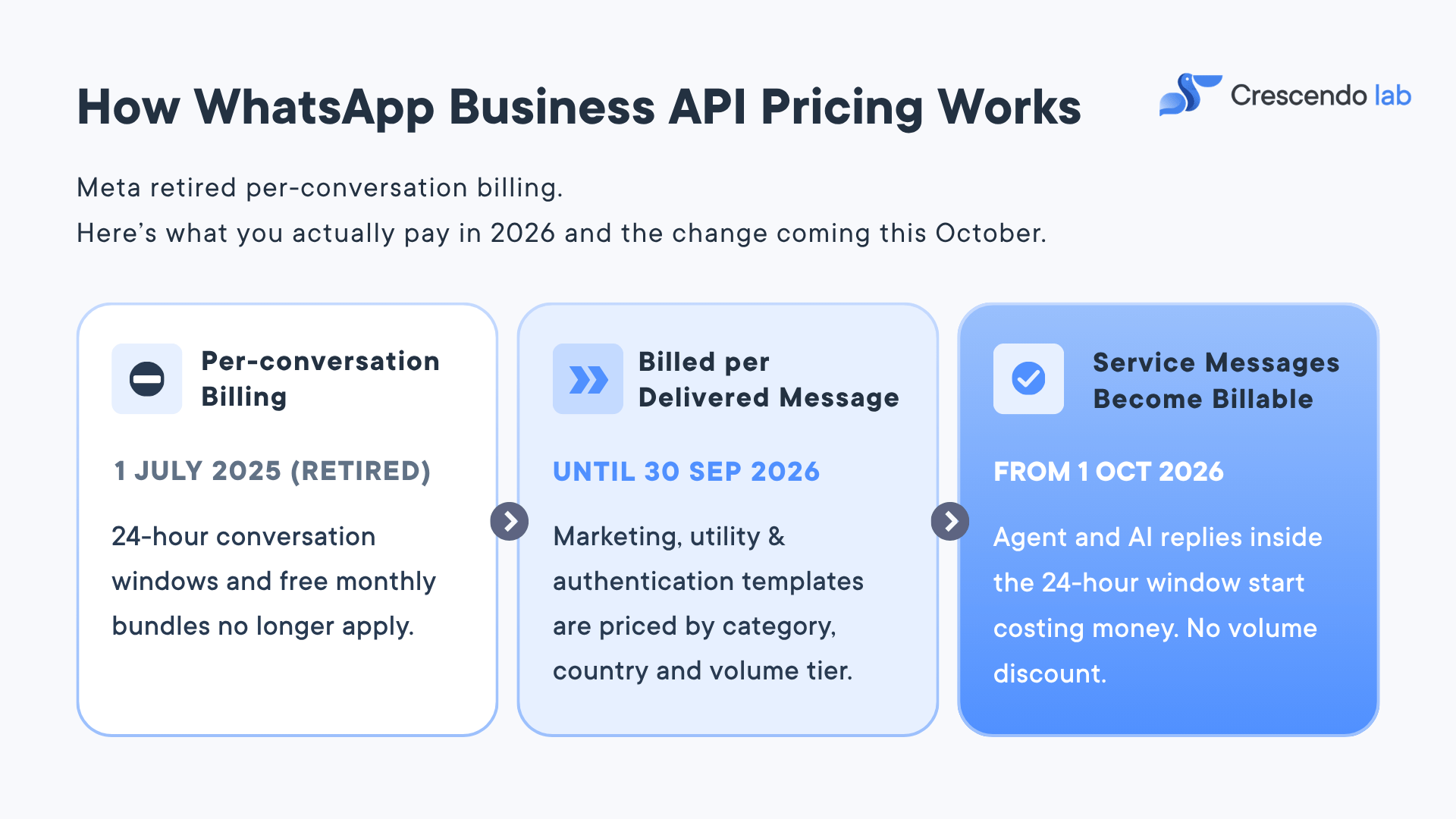
This is the single most important thing to understand, and it's where a lot of older guides are now wrong.
Meta bills per delivered message, not per conversation. On 1 July 2025, Meta moved off its old "per 24-hour conversation" model and switched to per-message pricing. Today you are charged each time a marketing, utility or authentication template message is delivered to a recipient — charged on delivery, not on send. The price depends on the message's category, the recipient's country, and any volume tier discounts.
If you read a guide that still quotes "per-conversation" rates or a bundle of "1,000 free conversations a month," it's describing the retired model. Ignore those numbers.
One more change is coming — mark your calendar. From 1 October 2026, Meta will start charging for service messages too. Service replies (a human agent or AI answering inside the customer's 24-hour window) have been free since November 2024. From this October, each one will be billed at the same per-message rate as utility and authentication in your market — with no volume discount. Replies sent by AI assistants running on the platform are also classified as service messages and will be billed. If customer support is a big part of your WhatsApp volume, this is a real line-item you should budget for now.
The Four Message Categories (and what each costs in Singapore)
Every message you send falls into one of four categories, and each has its own rate. Singapore is billed under Meta's "Rest of Asia Pacific" rate card.
| Category | What triggers it | Singapore rate (SGD, as of Jul 2026) |
|---|---|---|
| Marketing | Promotions, offers, product launches, re-engagement | ~S$0.0937 per message |
| Utility | Order confirmations, shipping updates, receipts, reminders (transactional, tied to an action) | ~S$0.0205 per message |
| Authentication | One-time passwords and verification codes | ~S$0.0205 per message |
| Service | Your replies within a customer's 24-hour window | Free until 30 Sep 2026, then ~S$0.0205 per message from 1 Oct 2026 |
A note on the numbers. Meta publishes its official rates in USD; the SGD figures above reflect the localized "Rest of Asia Pacific" card as commonly reported and tracked in July 2026. Currency conversions and rates change, so always confirm the live figure on Meta's official pricing page before you commit a budget.
Worked category examples:
- A flash-sale broadcast to your opted-in list = marketing, ~S$0.0937 each.
- An order-shipped notification = utility, ~S$0.0205 each.
- A login OTP = authentication, ~S$0.0205 each.
- A support agent answering a question within 24 hours = service, free today, ~S$0.0205 from October 2026.
What's Still Free on WhatsApp Business?
Even under per-message pricing, several things cost you nothing:
- Service replies inside the 24-hour window — until 30 September 2026. After a customer messages you, you have 24 hours to reply freely. (This benefit ends 1 October 2026, as above.)
- Free entry points. When a customer starts a chat by tapping a Click-to-WhatsApp ad or a WhatsApp button on your Facebook/Instagram Page, you get a 72-hour free messaging window with them. Routing acquisition through these ads is one of the cheapest ways to open conversations.
- The WhatsApp Business app itself remains free for manual, small-scale use.
The Total Cost Formula: Meta fees + BSP fee + add-ons
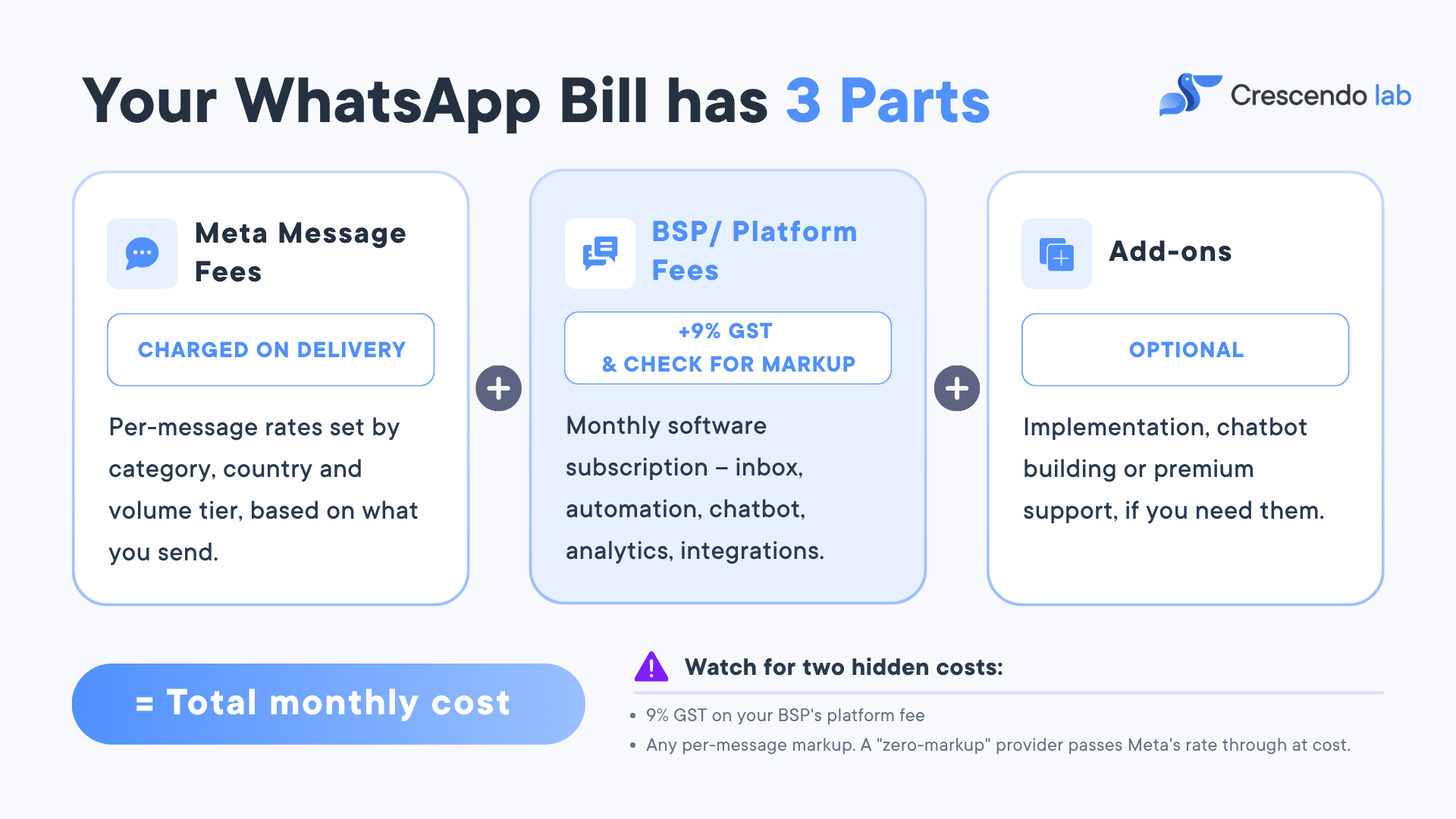
Your monthly WhatsApp bill is not just Meta's message charges. Use this simple formula:
Total cost = Meta message fees + BSP / platform fee + optional add-ons
- Meta message fees: the per-message rates in the table above, based on what you send.
- BSP / platform fee: a monthly subscription to your provider for the software (inbox, automation, chatbot, analytics, integrations). Some providers also add a per-message markup on top of Meta's rate; others don't.
- Add-ons: optional implementation, chatbot building, or premium support.
Two practical Singapore notes: your BSP's platform fee usually has 9% GST added on top, and if a provider charges extra per message on top of Meta's rate, that markup is the hidden cost to watch for. A "zero-markup" provider just passes Meta's rate straight through, with no extra fee added.
If you'd rather not piece this together yourself, an AI-powered WhatsApp customer service platform like Crescendo Lab's CAAC bundles the inbox, automation, AI agent and analytics into one platform fee, so the "BSP" part of the formula is a single, predictable line item.
Worked Cost Examples for a Singapore Business
Here's what real monthly bills look like. (Meta fees only — add your BSP fee and GST on top.)
Example A — SME, ~3,000 messages/month
| Category | Volume | Rate | Cost |
|---|---|---|---|
| Marketing | 2,000 | S$0.0937 | S$187.40 |
| Utility | 500 | S$0.0205 | S$10.25 |
| Authentication | 500 | S$0.0205 | S$10.25 |
| Meta subtotal | ~S$207.90 |
Example B — growing brand, ~30,000 messages/month
| Category | Volume | Rate | Cost |
|---|---|---|---|
| Marketing | 20,000 | S$0.0937 | S$1,874.00 |
| Utility | 7,000 | S$0.0205 | S$143.50 |
| Authentication | 3,000 | S$0.0205 | S$61.50 |
| Meta subtotal | ~S$2,079.00 |
Don't forget October 2026. If Brand B also handles, say, 5,000 support (service) replies a month, those are free today — but from 1 October 2026 they'll add 5,000 × S$0.0205 = ~S$102.50 to the bill. Small per message, but it compounds with support volume.
Your quick estimate: (marketing msgs × 0.0937) + (utility + auth + service msgs × 0.0205) + BSP fee + 9% GST on BSP fee.
WhatsApp vs SMS vs Email in Singapore
On raw unit price, WhatsApp marketing messages cost more than an SMS or an email. But that's the wrong comparison. WhatsApp open/read rates sit around 80–95%, versus roughly 15–30% for email and lower engagement for one-way SMS. Judge the channel on effective cost per outcome. A read, a reply, a sale — not cost per send. A message that's actually seen and acted on is cheaper per conversion even at a higher unit price.
How to Reduce your WhatsApp Business Costs
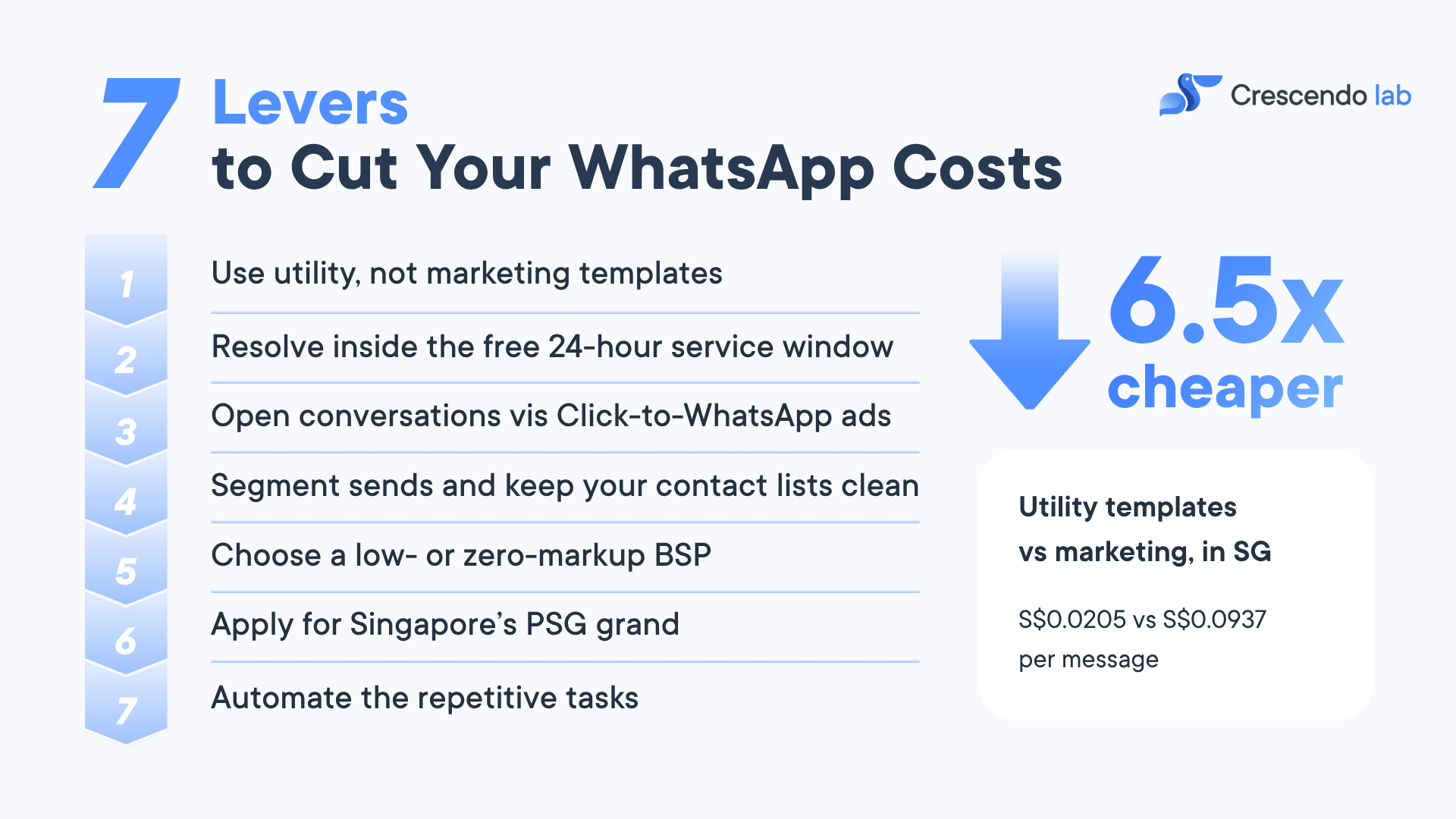
WhatsApp Business API costs can climb fast once you're sending at scale, but most of that spend is controllable. The per-message pricing model means small decisions (template type, list hygiene, provider markup, how much you automate) compound into real savings or real waste. Here are seven concrete levers to bring your WhatsApp costs down in Singapore, ranked by impact.
1. Use utility templates instead of marketing where you legitimately can.Utility is ~6.5× cheaper than marketing in Singapore (S$0.0205 vs S$0.0937). Transactional updates tied to a customer action qualify as utility — don't dress them up as marketing.
2. Resolve inside the free window (while it lasts).Answer within the 24-hour service window and, until October 2026, those replies are free. Efficient support workflows squeeze more resolution into that window.
3. Open conversations through Click-to-WhatsApp ads.They unlock the 72-hour free entry window, cheaper than cold outbound.
4. Segment and keep lists clean.Only message engaged, opted-in contacts. Blasting your whole list burns marketing spend on people who won't convert (and risks opt-outs).
5. Choose a low- or zero-markup BSP.Ask providers directly whether they mark up Meta's per-message rate, and what's included in the platform fee.
6. Apply for the PSG grant.Singapore's Productivity Solutions Grant can co-fund up to 50% of the cost of pre-approved digital solutions via GoBusiness. Eligible messaging/ CRM platforms can qualify — a Singapore-specific lever most global guides skip.
7. Automate the repetitive stuff.The more FAQs and routing you automate, the faster agents resolve conversations. Crescendo Lab's CAAC AI customer service and sales platform auto-replies to common questions, routes chats, and tracks revenue per conversation — which matters more than ever once service messages become billable in October 2026. If you're just getting started and want a fast, self-serve way onto WhatsApp Business, CAAC Go gets you live quickly without a heavy setup.
One compliance reminder: Singapore's PDPA requires clear opt-in consent before you message people. Keep your consent records clean since it protects you legally and keeps your lists high-quality, which also keeps costs down. See the PDPC for the current obligations.
Ready to automate your WhatsApp support? CAAC Go helps you get started quickly with AI-powered customer conversations. Start today!

Rates in this article reflect Meta's Singapore ("Rest of Asia Pacific") rate card as of July 2026 and are subject to change. Always verify current figures on Meta's official pricing page before finalising a budget.
Conclusion
With WhatsApp pricing evolving in 2026, reviewing your messaging strategy now can help you avoid unnecessary costs. Looking for a cost-effective solution? Crescendo Lab's CAAC helps you automate conversations while keeping pricing transparent.


Ainee S.
Thai Content Marketer at Crescendo Lab (-: