
Table of Contents
Missed calls and unanswered website enquiries are quietly costing Australian businesses bookings every single day. An AI receptionist promises to fix that — answering customers instantly, around the clock, without adding headcount. But what exactly is one, how much does it cost in Australian dollars, and is it even legal under our privacy laws? This guide walks through everything an Australian business owner needs to know before choosing one in 2026.
What is an AI receptionist?
An AI receptionist is software that greets customers, answers their questions, captures their details, and books appointments automatically — 24 hours a day — using conversational artificial intelligence instead of a human at a front desk. It can run on your phone line (voice), on your website chat, or through messaging apps like WhatsApp.
It's more than a scripted chatbot. A modern AI receptionist understands what a customer actually means, replies in natural language drawn from your own business information, and knows when to hand a tricky conversation to a real person. Think of it as a digital front desk: always on, never flustered, and able to handle dozens of enquiries at once.
There are two broad types. Voice AI receptionists answer inbound phone calls and speak with callers. Digital AI receptionists — like an AI website agent — answer visitors on your website and messaging channels in text. Many Australian businesses end up using both, because customers reach them by phone and online.
How does an AI Receptionist Work?
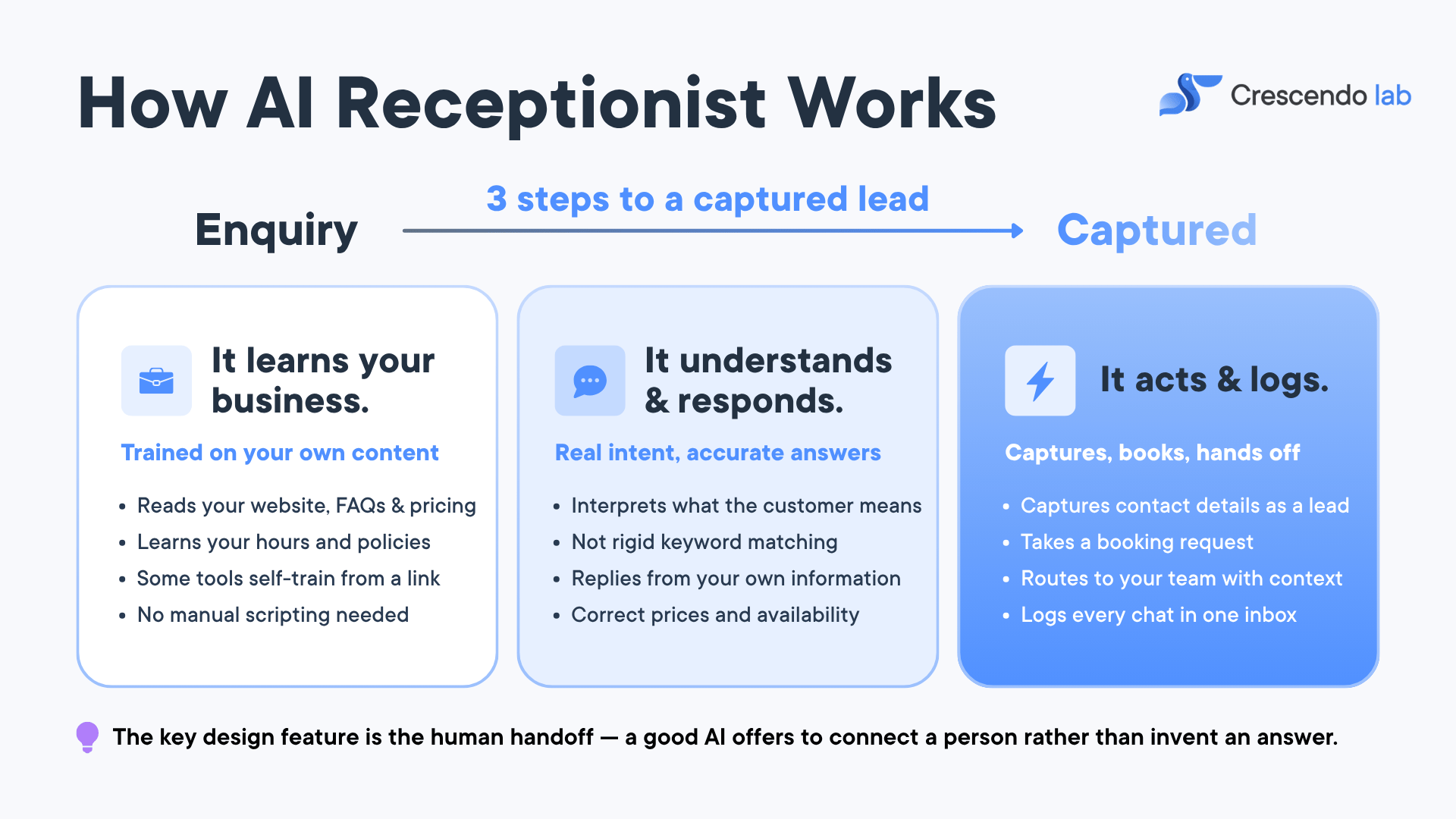
Under the hood, the process is simpler than it sounds:
1. It learns your business. You give it your source material — your website pages, FAQs, pricing, opening hours, and policies. Some tools require manual configuration; others, such as CAAC Go, train themselves by reading your website after you paste in a link.
2. It understands the enquiry. When a customer calls or messages, the AI interprets their intent — a booking request, a pricing question, a complaint — rather than matching rigid keywords.
3. It responds accurately. It generates a reply from your information, so customers get correct details about your services, prices, and availability instead of generic guesses.
4. It acts. It captures the customer's contact details as a lead, takes a booking request, or routes the conversation to your team with full context.
Read more:Replacing static forms with conversational marketing
5. It logs everything. Every interaction lands in one place — a unified inbox and analytics dashboard — so nothing falls through the cracks.
The critical design feature is the human handoff. A well-built AI receptionist recognizes the limits of its knowledge and offers to connect a person rather than inventing an answer.
AI Receptionist vs Virtual Receptionist vs Human Answering Service
"AI receptionist," "virtual receptionist," and "answering service" are often used interchangeably, but they're different things. Here's a decision framework most comparison articles skip:
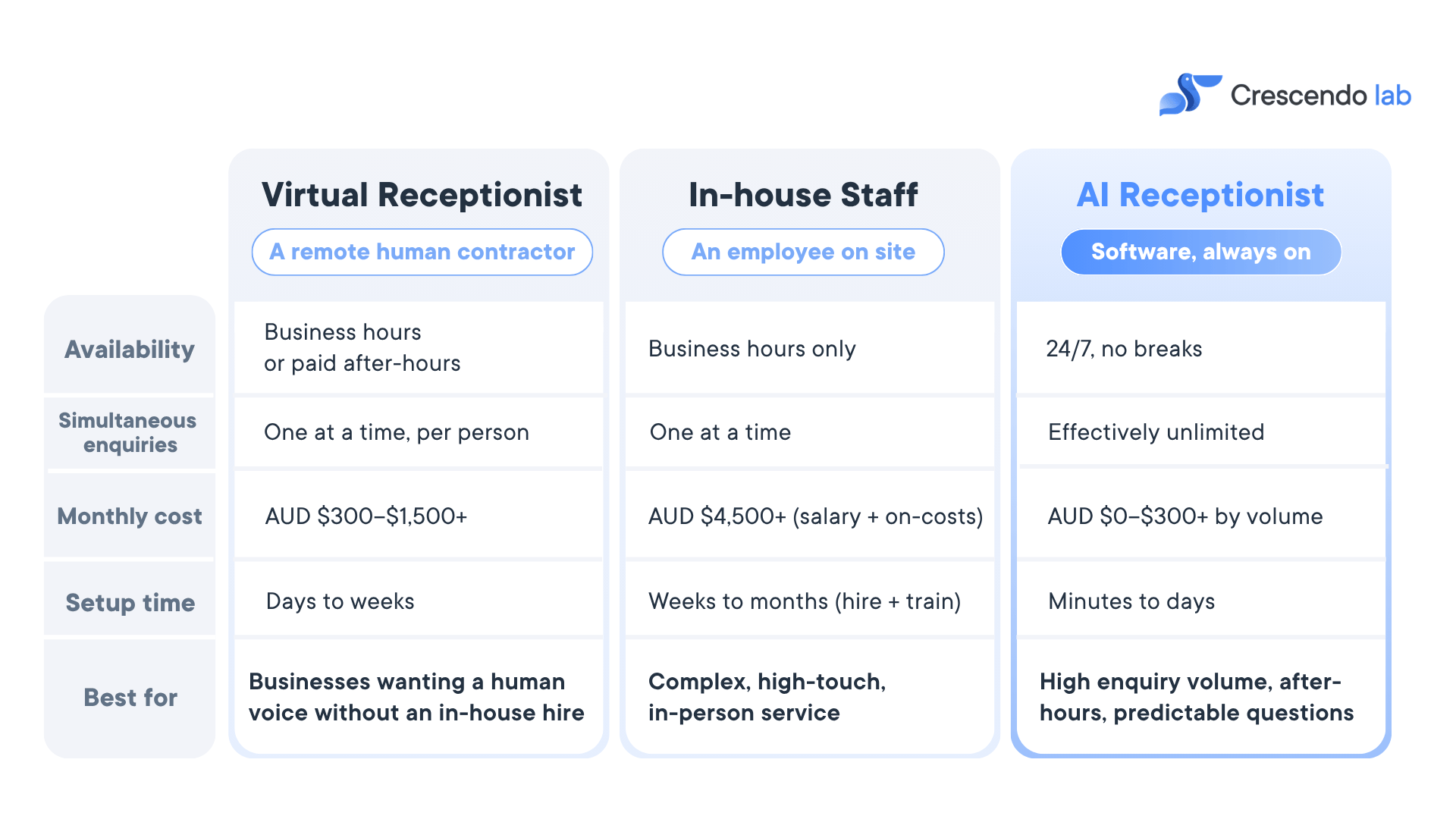
The honest takeaway: an AI receptionist is strongest for volume, speed, and after-hours coverage. A human is still better for nuanced, emotionally sensitive, or highly complex conversations. Many Australian businesses run a hybrid — AI handles the routine 70–80%, humans take the rest.
Read more:How one retail brand uses an AI agent to handle 75% of inquiries and save 160 hours a month)
How much does an AI receptionist cost?
Australian pricing for AI receptionists generally falls into three bands. Note these are indicative market ranges as at July 2026 — always confirm current pricing directly with each vendor, as plans change.
- Entry / free tier (AUD $0–$50/month): Website chat agents and starter voice plans. Good for low volume, single location. Often limited by the number of conversations or minutes per month.
- Small-business tier (AUD $50–$300/month): More conversations, integrations with your calendar and CRM, lead export, and multiple team seats. This is where most SMBs land.
- Volume / enterprise (usage-based): Priced per minute (voice) or per conversation (chat), scaling with call volume. Best for high-traffic businesses.
Two pricing models dominate. Per-minute or per-conversation pricing scales with usage — cheaper when quiet, more expensive at peak. Flat subscription pricing is predictable but can waste spend in slow months. Watch for add-on costs: extra integrations, additional languages, and premium support.
As a concrete example, Crescendo Lab's CAAC Go pricing starts with a free plan (200 AI conversations/month) and moves up through paid tiers as your conversation volume grows, with lead capture and the unified inbox included on every plan. (Plan prices are listed on the pricing page; confirm the figure and currency that applies to your account.)
Is an AI receptionist compliant with Australian privacy law?
This is the question most global comparison articles ignore entirely — and it's the one Australian clinics, law firms, and financial services care about most.
An AI receptionist handles personal information: names, phone numbers, health or financial details, and recorded conversations. That brings it under the Privacy Act 1988 and the Australian Privacy Principles (APPs), administered by the Office of the Australian Information Commissioner (OAIC). Key considerations:
- Call recording and consent. If your voice AI records or transcribes calls, you generally need to notify callers. Recording laws also vary by state and territory, so check your local rules.
- Collection and use (APP 3 & 6). You should only collect personal information you reasonably need, and use it only for the purpose you collected it for.
- Data security (APP 11). You must take reasonable steps to protect personal information. Ask vendors how data is encrypted and stored.
- Data sovereignty. Where is the data hosted? Some Australian businesses — particularly in health and government-adjacent sectors — prefer data kept in-region.
- Cross-border disclosure (APP 8). If a vendor stores or processes data overseas, you have obligations around that disclosure.
A practical buyer's checklist: ask any vendor (1) where data is stored, (2) whether it's encrypted at rest and in transit, (3) whether your data is ever used to train shared models or sold, and (4) whether you can export or delete it on demand.
For reference, CAAC Go states that customers own their data and it is never sold, that connected credentials are encrypted at rest with AES-256, that each workspace is isolated, and that data is hosted on Google Cloud (Asia-Pacific) — you can review the specifics on its security and privacy pages. Whatever tool you choose, get these answers in writing.
This section is general information, not legal advice. Confirm your specific obligations with the OAIC guidance or a qualified adviser.
Best AI Receptionist Tools for Australian Businesses (2026)
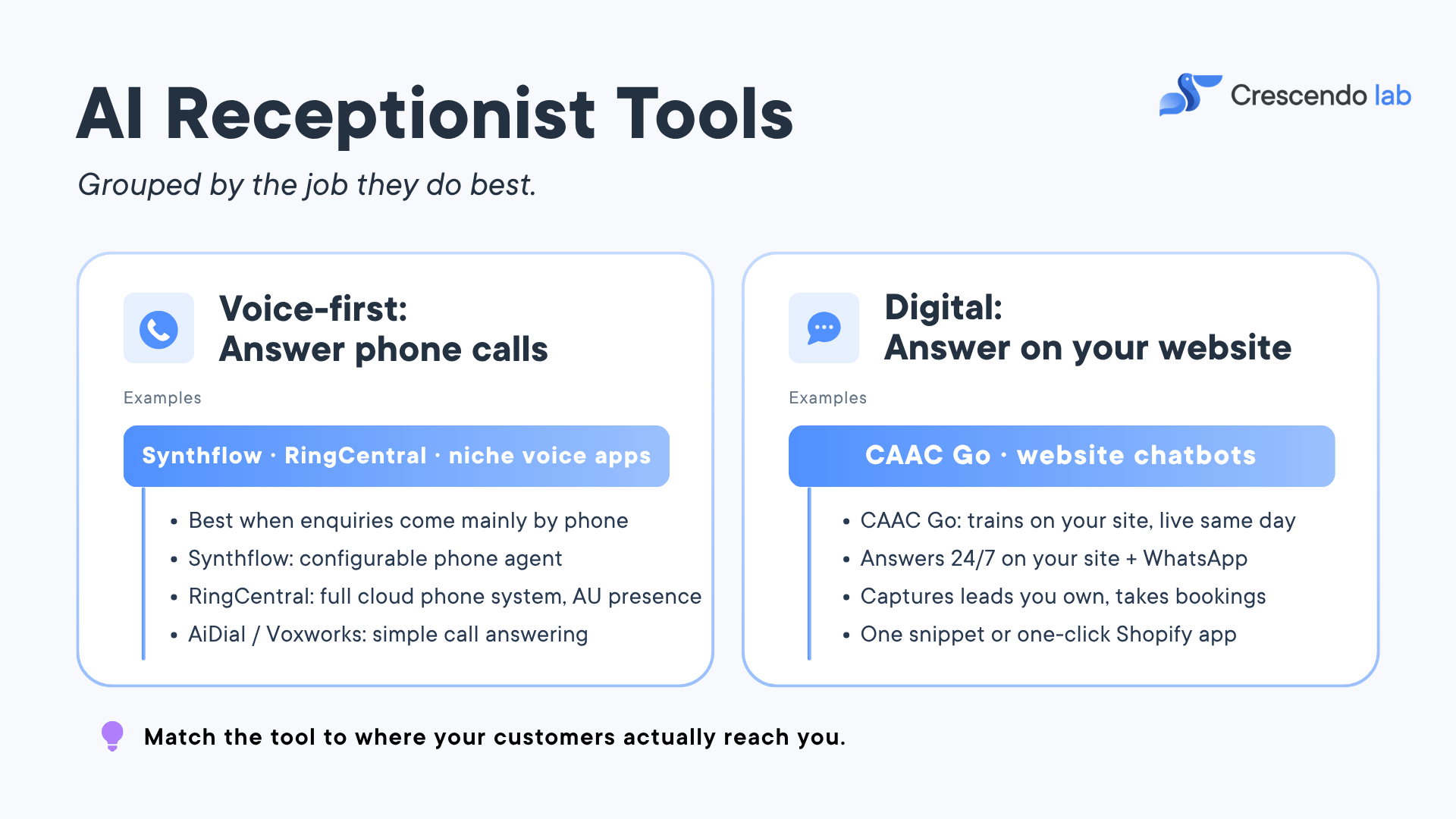
The tools are grouped by the job they do best, not ranked one-to-ten, because the right choice depends on whether you need voice, chat, or both. Descriptions reflect each vendor's publicly stated features and are accurate to the best of our knowledge as at July 2026; features and pricing change, so verify the current details on each vendor's own website before buying.
Voice-first AI receptionists (answer phone calls):
- Synthflow — A voice AI agent builder aimed at teams that want to configure a phone agent and integrate it with their tools. Best for businesses whose enquiries come mainly by phone.
- RingCentral — A established business communications platform with AI receptionist capabilities layered onto a full phone system, with an Australian presence. Best for businesses that also want a complete cloud phone system.
- AiDial / Voxworks / similar voice specialists — Niche voice-answering tools positioned at small businesses wanting straightforward call answering. Best for single-purpose phone cover.
Digital / website AI receptionists (answer online):
- CAAC Go (Crescendo Lab — our product): A self-serve AI website agent that trains itself on your existing website content, answers visitors 24/7 on your site and WhatsApp, captures leads you own, and takes booking requests — installed with one snippet or a one-click Shopify app. Best for businesses whose customers arrive through their website and want a digital front desk live the same day. Free plan available; see it running on your own site.
- General website chatbots — Broader chatbot platforms can be configured as website receptionists but often need more manual setup. Best for teams with time to build.
How to choose: if your enquiries come by phone, start with a voice-first tool. If they come through your website or messaging, start with a digital agent. Match the tool to where your customers actually reach you, then check pricing, integrations, and — for Australian businesses — the privacy commitments covered above.
AI Receptionists by Industry
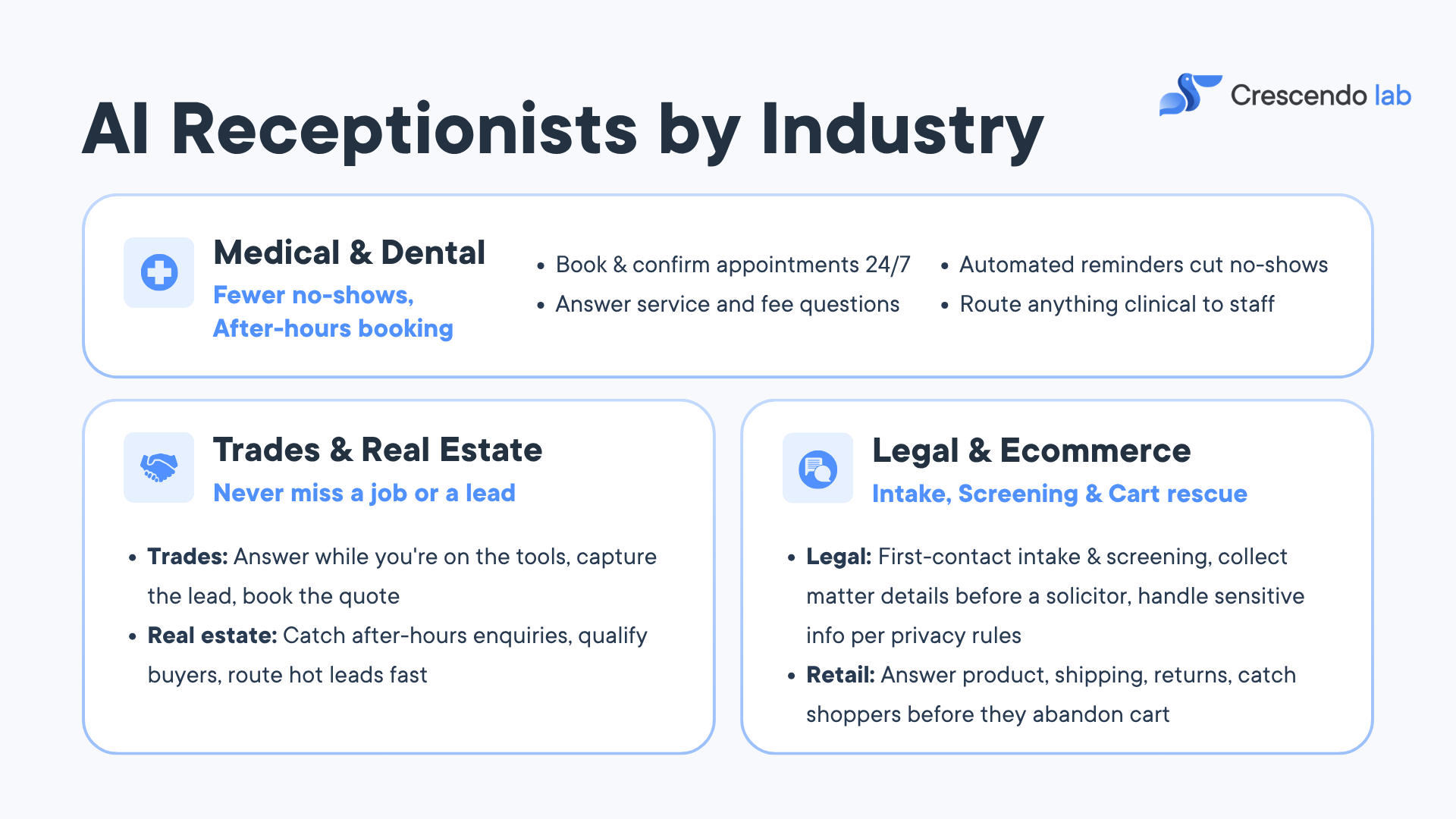
Different sectors use an AI receptionist differently:
- Medical & dental clinics. Book and confirm appointments after hours, answer questions about services and fees, and cut no-shows with automated reminders — while routing anything clinical to staff.
- Trades (plumbers, electricians, builders). Never miss a job because you're on the tools. An AI receptionist answers while you work, captures the lead, and books the quote.
- Real estate. Capture after-hours enquiries on listings, qualify buyers and renters, and route hot leads to agents instantly.
- Legal & professional services. Handle first-contact intake, screen enquiries, and collect matter details before a solicitor picks up — with sensitive information handled per your privacy obligations.
- Ecommerce & retail. Answer product, shipping, and returns questions before a shopper abandons the cart — exactly the job a website AI agent that captures every lead is built for.
Beyond the Enquiry: Turning first contact into a booked customer
Here's the part most AI receptionist tools miss. Answering the question is only step one. The real value is what happens next — turning that first contact into a booking, a sale, or a repeat customer.
That's the gap a digital-front-desk approach closes. Because a tool like CAAC Go captures the visitor's details as a lead you own — not a lead that's sold on — the conversation doesn't end when the customer closes the tab. It lands in a unified inbox where your team can pick up with full context, and every after-hours enquiry is waiting for you in the morning instead of lost overnight.
For businesses that also talk to customers on messaging, the same agent can answer on WhatsApp, so a website visitor and a WhatsApp enquiry both flow into one place. And because CAAC Go is built on the enterprise CAAC platform trusted by 800+ global brands, businesses that outgrow the self-serve tier can graduate to full CRM, automated customer journeys, and multi-channel AI without switching systems.
The result is a front desk that doesn't just answer — it captures, follows up, and grows revenue. You can start free with no code and see it working on your own website in minutes.
Need a personal AI Receptionist on a budget? Start free with CAAC Go — train an AI agent on your website and answer visitors 24/7.


Ainee S.
Thai Content Marketer at Crescendo Lab (-: